
When I decided to start this project, I mulled over some different names, but Keshkek Meshkek kept coming back to me. In Turkish, if you want to emphasize a word, you take the word and repeat it, changing the first letter to an ‘M.’ It’s a way of saying ‘etcetera,’ or all things related to the topic. One memory comes to mind from when my husband and I were planning our wedding. I overheard him telling a neighbor “and you know, we’ll have keshkek meshkek.” My Turkish was terrible at the time, but I remember I knew exactly what he was trying to convey. We were going to have a day of celebration with food and music, family and community, and all that comes along with it. So what is keshkek?
Keşkek (keshkek) is a savory boiled wheat porridge or stew. Weddings, celebrations and sometimes funerals are often marked by this dish. In villages like ours, on the Black Sea, the women will start the preparations the night before by soaking the wheat. The next day it is cooked in giant pots over an open fire. The ladies stir and stir all the while feeding the fire; I think their labor is part of what makes it so good. My mother-in-law makes wonderful keşkek; it is notably also my favorite Turkish dish: such a simple but gratifying meal.
Additionally, what resonated with me was the Turkish word meşk (meshk) which literally means ‘to practice.’ Whether that be something like music or painting, it is the drawn out process of learning how to live with your craft, and eventually falling in love with it. In fact, the words aşk meşk mean, “a love affair.” From the word meşk comes meşakkat, which is associated with difficulties experienced during a spiritual journey.
I didn’t love living in Turkey for a long time, in fact, I didn’t really even like it. There were elements that I loved, but for the most part it, took a lot of time and practice to figure out what my role was within this new life I was building. But pieces began to fall into place, and eventually I found my gait, and began living what I understood keshkek meshkek to mean those years ago.
There are many ways to make keşkek: each village or region has their own method. For example, my mother-in-law adds beans to hers, but most do not. I have tasted a lot of it over the years, and I still feel my mother-in-law’s is the best. This recipe will feed a group, which is how it’s intended to be eaten.
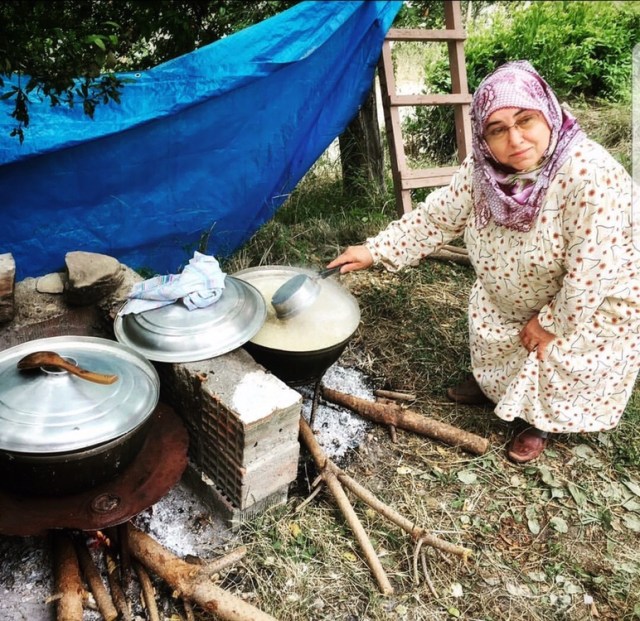
Katibe’s Keşkek
Ingredients
3 Cups* of Wheat
3 Cups of Dried Cannellini Beans
1 Large Onion
2 Heaping Spoonfuls of Butter
A Glug of Olive Oil
A Spoonful of Tomato Paste
Pul Biber or Aleppo Pepper to Taste – you can substitute crushed chili flakes
Salt to Taste
*Many Turkish recipes are written with measurements based on common kitchen items. For example, my mother-in-law told me, 3 water glasses full of wheat and 3 water glasses full of beans. Other measurements are tea glasses, and tea spoons. I measured a water glass and it is equal to one cup.
Method:
Soak the beans and wheat overnight, rinse.
Add the beans and the wheat to a stew pot.
Add enough water to cover and cook for several hours, stirring often, adding water when necessary. The goal is to get a nice near porridge-like consistency. But still runny, not thick and gloopy.
Dice the onion and in a frying pan add the butter and a generous amount of olive oil. My MIL is heavy handed with oil. Normally I am horrified, but with the keşkek I do think it is part of the charm.
Fry the onions.
Add the red pepper flakes.
Add the tomato paste.
Drizzle mixture over the beans and the wheat and stir.
Salt to taste.
Many recipes call for some kind of meat. Lamb and beef are popular, but I have seen chicken as well. Typically, because it is village food and meat is expensive, you see stew bones added with just a bit of meat for flavor: it’s a wheat dish not a meat dish.
I would use beef or chicken stock in place of water, preferably homemade.
Serve with crusty bread and pickled green peppers!
 Keshkek Meshkek